
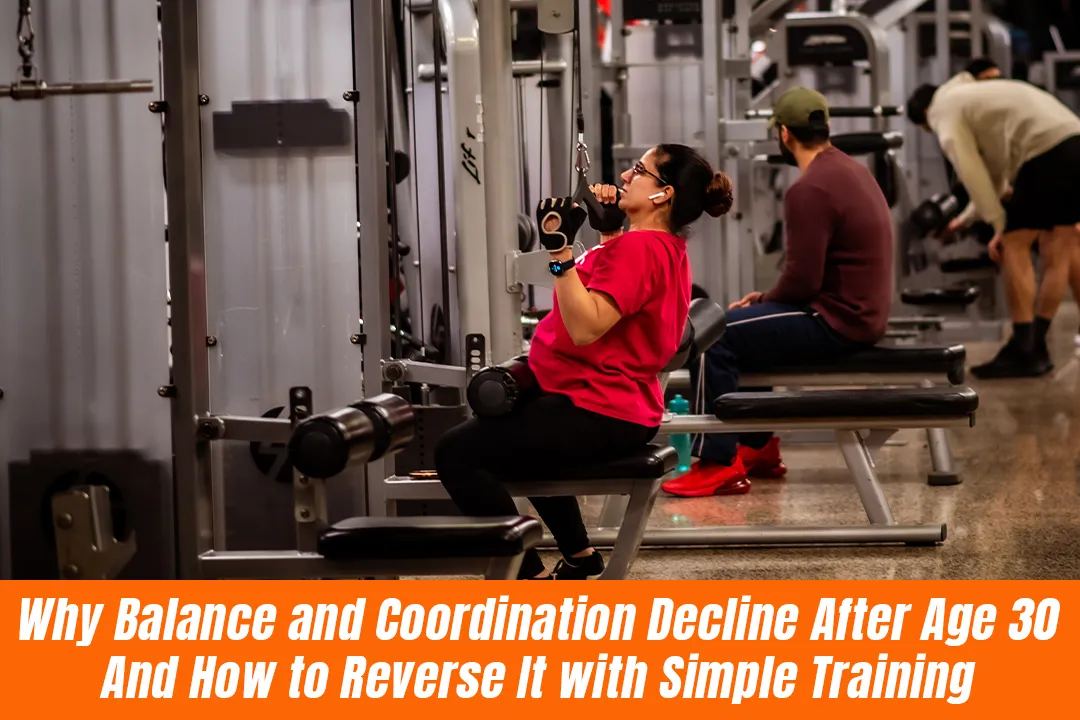
Most of us are not conscious that the functions of balance and coordination start to be lost at the age of 30. It is a gradual process and not a binary change. Slightly less steady, tighter hips, and simple movements that are not as fluid as before are some of the conditions people experience.
What is even better is that balance can be practiced a lot. With the proper technique, you can recover stability, increase your coordination and move around with confidence no matter how old you are. Moreover, if you are looking for a 24-hour gym nearby, having a fixed routine will make this journey much more manageable.
Once the late twenties are over, the reduction of muscle mass, joint mobility, and neural responsiveness starts to happen in a gradual and slow way if not actively maintained. The muscles around your hips and core might become weaker, the inner ear might be a little bit less sensitive, and sitting for a long time might decrease the movement of the joint. Just to name a few, small changes in lifestyle like less walking, more screen time and higher stress level contribute to the slow decline of these functions.
These transformations do not necessarily mean that a person is getting old in a bad way; they are just signals that the body needs to be kept sharp by consistent movements, strength training, and mobility exercises.
The importance of good balance is not only in preventing falls, but it is also the basis of all movements you do, i.e., climbing up and down stairs, playing sports, running, or lifting weights, even standing for long time. Balance is responsible for joint protection, good posture and decreasing injury risk. As a person ages, balance is the prime factor for the long run mobility and independence.
Once the balance gets worse, your body begins to adjust by adopting poor movements, which, in turn, may cause chronic pains or the decline of your performance.
The most effective method for improving balance, probably, is strength training; the greater the power of your muscles, the more the stability of your joints will be. Lower body, butt, and trunk workouts give your body assistance during locomotion and also help you to be steady. Exercises like squats, deadlifts, lunges, step-ups, and core variations all work for the improvement of your balancing ability in everyday tasks.
Gradually, the muscles recover their ability to respond quickly and vigorously — a point that is very important for coordination. A significant number of trainers, therefore, focus on working out the strength with the combination of slow, controlled movements that improve the awareness of one’s body.
You don't need complicated workouts for improving balance. Even simple exercises, such as one-legged stands, walking heel-to-toe, slow step-downs, or controlled core exercises, will go a long way in rebuilding the mind–muscle connection.
Moreover, incorporating mobility exercises for the hips and ankles brings back the fluidity of movement which is a key factor in maintaining balance. Furthermore, the majority of the individuals gain from barefoot training or using light footwear since this practices develops the muscles of the foot which are responsible for stability and support.
Another option is to take part in
functional training classes where a guiding support system will ensure you practice balance through natural movement patterns, gentle agility exercises, and core strengthening-all under the supervision of qualified instructors.
If an environment that is supportive and well-equipped is available, then it is not hard at all to have a regular training schedule. Hence, choosing a place like
Fitness center Truganina could actually change the whole scenario. Possession of proper gear, trainers who are well informed about the mechanics of movement, and a safe area to practice, you will have a better chance of adhering to a balanced training regimen.
Most people will see a huge improvement in just a few weeks by following a simple, repeatable program. Consistency rather than high intensity is the secret of the long-term balance and coordination maintenance.
The decline of natural balance begins in a person's 30s but it can be reversed. The ways to regain the youth's stability regardless of one's age are through strength training, mobility exercises, and simple coordination drills, among others. The most important thing is to have regular moves, intentional training, and a safe place that encourages your goals.
Your body is capable of adapting, it just needs the right stimulus.