
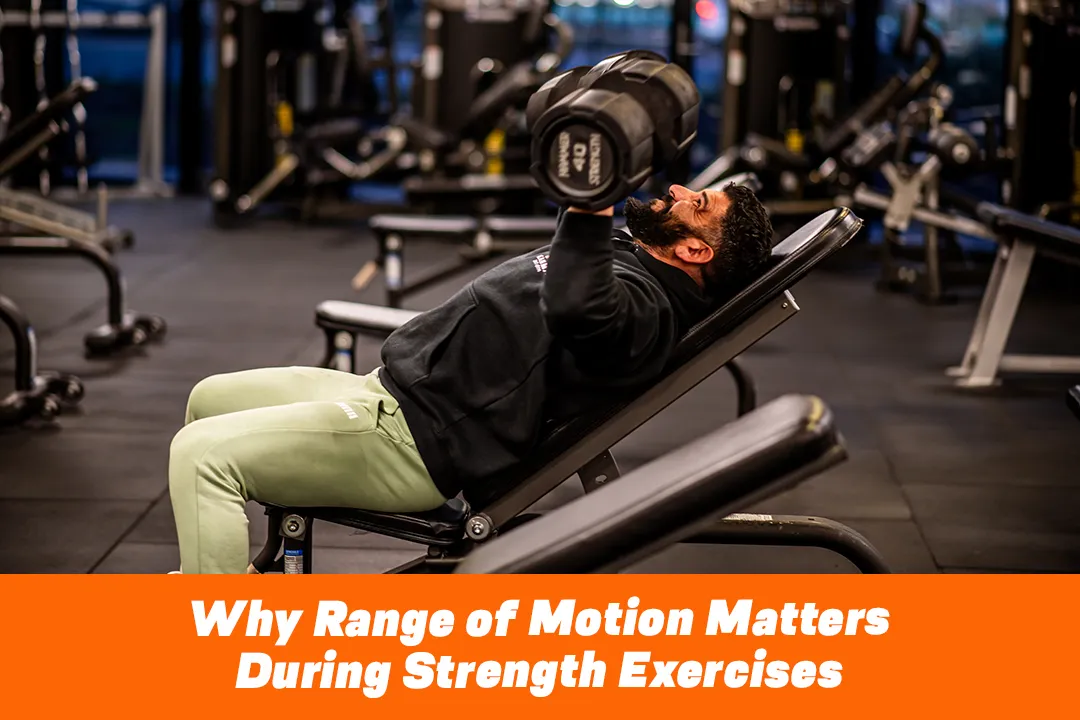
When it comes to strength training, many people focus on how much weight they can lift or how many repetitions they can complete. However, another important factor often receives less attention: range of motion. The range of motion refers to how far a joint moves during an exercise, from the starting position to the finishing position.
Using an appropriate range of motion can make strength exercises more effective by encouraging controlled movement, improving mobility, and helping muscles work through their intended movement patterns. It is not always about moving as far as physically possible. Instead, the goal is to use a range that is suitable for the exercise, your body, and your current level of mobility.
Range of motion describes the amount of movement available at a joint during an exercise. For example, when performing a squat, the distance your hips and knees travel as you lower and raise your body contributes to the movement's range of motion.
Different exercises require different ranges because every joint and movement pattern is unique. A person's mobility, flexibility, training experience, and physical structure can also influence how comfortably they can perform a movement.
Understanding range of motion helps you focus on performing exercises with control rather than simply trying to move through repetitions as quickly as possible.
Using an appropriate range of motion allows muscles to work through more of the movement required by an exercise. When repetitions are rushed or shortened unnecessarily, some of the intended movement may be missed.
Controlled movement also makes it easier to maintain proper positioning throughout each repetition. This can improve exercise technique and help you become more aware of how your body moves.
For people participating in weight training Truganina programs, learning how to perform exercises through a suitable range can be more valuable than immediately trying to increase the amount of weight being lifted.
Strength development is influenced by several factors, including resistance, training volume, technique, and consistency. Range of motion is another important part of the equation because muscles may experience different demands depending on how an exercise is performed.
For example, performing a squat through a controlled and appropriate depth can challenge the muscles differently from performing very shallow repetitions. Similarly, exercises involving the upper body can place different demands on muscles depending on how far the joints move.
This does not mean that everyone needs to use the deepest or largest possible range. The most effective range is one that can be performed safely and consistently while maintaining good technique.
Mobility and strength are closely connected. Having adequate mobility allows you to move through the positions required by an exercise, while strength helps you control those positions.
Regular strength exercises performed with appropriate movement can help reinforce useful movement patterns and improve confidence in physical activity. Over time, this can make everyday movements such as reaching, bending, lifting, and getting up from a chair feel more comfortable.
A balanced
strength and conditioning Truganina program can incorporate mobility, resistance, and functional movements to help develop strength while supporting overall movement quality.
It is easy to assume that a larger range of motion automatically makes an exercise better. However, pushing beyond a person's comfortable or appropriate range can compromise technique and make it harder to control the movement.
Everyone has different mobility levels and physical structures, so exercises should be adapted accordingly. A beginner may initially use a smaller range and gradually develop greater control and mobility through consistent training.
The key is not to force a particular depth or position. Instead, focus on maintaining good alignment, controlled movement, and a range that suits your body and the exercise.
Improving range of motion begins with learning how an exercise should feel and understanding the correct movement pattern. Start with a manageable resistance and focus on completing each repetition slowly and deliberately.
A mirror, trainer, or experienced training partner can sometimes help you identify whether your movement is consistent throughout the exercise. As your technique improves, you can gradually adjust resistance or movement difficulty.
For those new to resistance exercise, starting with guidance can make the learning process easier. Weight training in Truganina sessions can provide an opportunity to develop proper movement habits before progressing to more challenging exercises.
Range of motion is an important part of effective strength training, but it should never be viewed in isolation. Good results come from combining appropriate movement, resistance, technique, recovery, and consistency.
Instead of focusing solely on lifting heavier weights, pay attention to how you perform each repetition. Moving with control and using a suitable range can help you get more from your workouts while developing greater awareness of your body's movement.
Whether you're new to strength training or have been exercising for years, improving movement quality can make your workouts more productive and help create a stronger foundation for long-term fitness.